Manual Therapy: Your Body Whispers Before It Screams
Your body whispers before it screams.
Tight hips. Stiff shoulders. Nagging knee pain. These aren’t just inconveniences. They’re alarm bells.
Your movement patterns are corrupted. Your fascia is locked up. Your body is compensating. Adapting. Slowly breaking down.
You can snooze these whispers and wait for the scream. Or you can decode the signals before they become injuries.
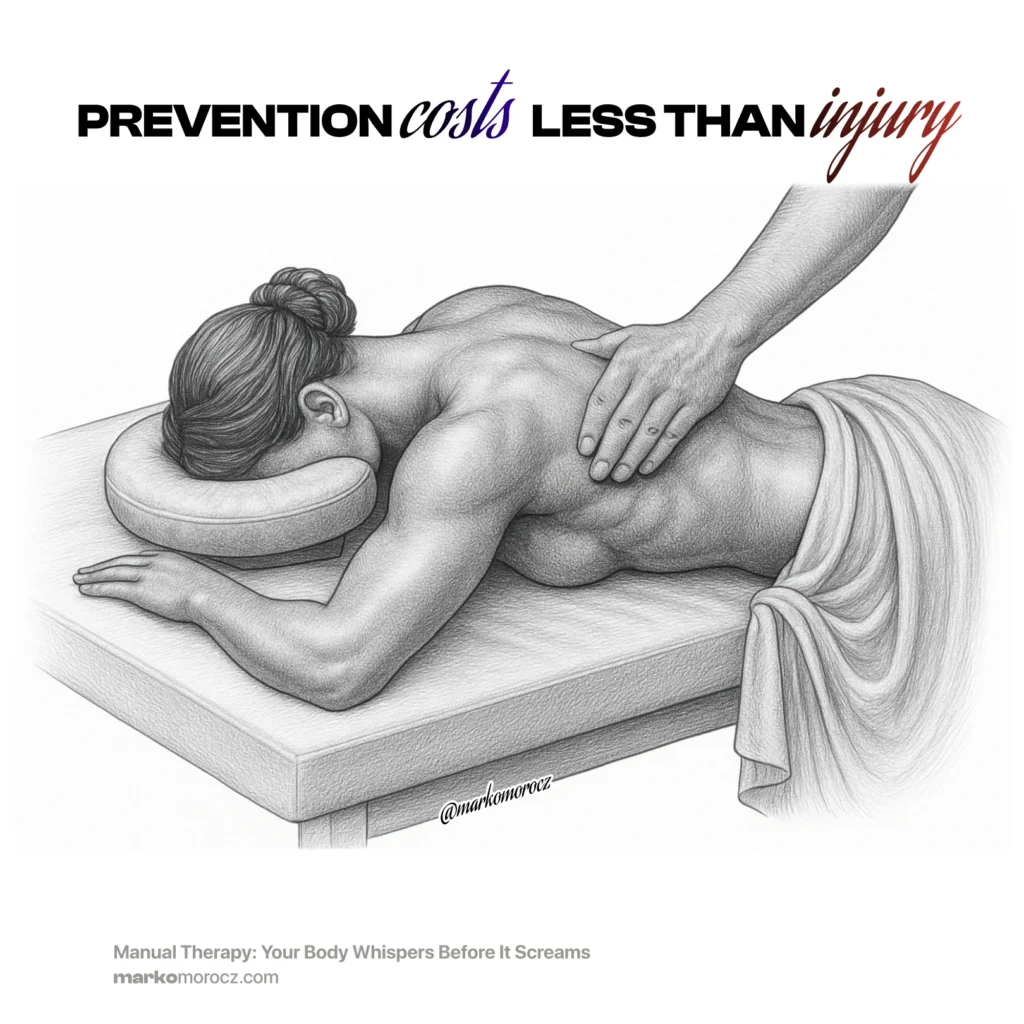
That’s where manual therapy comes in. Not as luxury. As maintenance.
The Hidden War Inside Your Body
Every day, your body fights a silent battle.
Sitting at desks corrupts your posture. Training creates micro-trauma. Stress locks muscles into protective patterns. Life itself creates dysfunction.
Your body adapts brilliantly. Compensating for weaknesses. Working around restrictions. Finding alternative movement paths. But adaptation has limits.
Eventually, compensation becomes dysfunction. Dysfunction becomes pain. Pain becomes injury.
The research is clear:
- 70% of running injuries are due to biomechanical faults1
- Athletes with movement dysfunction have 3x higher injury rates2
- Manual therapy reduces injury risk by up to 50% when combined with corrective exercise3
Your choice: address imbalances now, or meet them as injuries later.
The Osteopathic Advantage: Seeing The Whole System
Osteopathy isn’t massage. It’s detective work.
While massage therapists work on muscles, osteopaths read the entire kinetic chain. They understand that your knee pain might originate from your hip. Your shoulder dysfunction might start at your thoracic spine.
The Osteopathic Principles
- The body is a unit: everything connects to everything
- Structure governs function: poor alignment creates poor movement
- The body has self-healing mechanisms: when restrictions are removed
- Rational therapy follows understanding: fix the cause, not just symptoms
An osteopath doesn’t just treat where it hurts. They trace the dysfunction to its source.
Here’s the difference. Medicine 2.0 looks at your MRI and sees damaged cartilage. A broken part needing fixing. Medicine 3.0 sees the tight psoas from sitting, weak hip abductors, and pelvic dysfunction that created the damage in the first place.
Same body. Different lens. Different outcome.
When my knee cartilage showed up thin as a 45-year-old’s at age 29, traditional medicine would focus on the cartilage itself. Maybe joint supplements. Maybe warnings about future surgery.
Functional medicine traced it back to my sprinting career, excessive barefoot running, and years of desk work corrupting my movement patterns.
Treat the cause, not just the symptom. That’s the osteopathic advantage.
The Professional Touch Arsenal
Different problems need different weapons.
Osteopathy treats your body like a connected system. Your knee pain might start in your hip. They find the real source, not just where it hurts.
Deep tissue massage breaks up the knots and adhesions that training creates. Think of it as maintenance for your engine—keeping everything running smooth.
Sports massage is performance-focused. Pre-competition prep, post-workout recovery, and everything in between. It’s massage with a purpose.
Myofascial release targets your fascia—the connective tissue wrapping your muscles. When this gets sticky, everything feels tight and restricted.
Dry needling goes straight for trigger points with fine needles. Sounds scary, works brilliantly for specific problem spots.
The key? Find practitioners who understand your goals, not just generic relaxation.
Why Skilled Hands Beat Any Machine
Your body craves human touch. Not just emotionally—biologically.
Skilled manual therapy does what no machine can. It calms your nervous system4. Reduces stress hormones by up to 31%5. Triggers your body’s natural healing response. Blood flow increases by 30-40%6. Inflammation drops7. Recovery accelerates8.
The performance benefits? Your range of motion improves by 20-30%9, power output increases by 15%10, and that post-workout soreness gets cut in half11. Your body literally functions better after skilled hands work on it.
Technology can measure your dysfunction. But only hands can heal it.
The Transformation: How You’ll Feel After Professional Care
Walk into the session feeling like a rusted machine. Walk out feeling like a Formula 1 car.
Immediately: Your body feels lighter. That chronic shoulder tension? Gone. The hip barking during squats? Silent. Full range of motion returns. Breathing deepens. Posture improves automatically.
48 Hours: Movement quality jumps. Squat depth improves without effort. Running stride smooths out. Morning stiffness drops from 30 minutes to 5.
Long-term: You move like water instead of rust. Sleep improves. Energy increases. Performance jumps. You feel 20 years younger.
The investment isn’t just in treatment. It’s in rediscovering what your body is capable of when it’s not fighting itself.
How Smart Therapists Actually Work
Good therapists don’t guess.
They investigate. They watch how you move. Feel where you’re restricted. Trace your pain to its actual source. Your knee might hurt because your hip is locked up. Your shoulder might be screaming because your thoracic spine can’t rotate.
Then they work systematically—nervous system first, restrictions second, movement patterns last.
Think of it like debugging code. Fix the operating system before tweaking the applications. Address the foundation before building the house.
This systematic approach is what separates skilled practitioners from expensive massage parlors.
When Your Body Needs Professional Help
Your body whispers before it screams. Learn the language.
Emergency signals: Sharp pains, numbness, significant swelling, or night pain that disrupts sleep. These need immediate attention.
Warning signals: Morning stiffness that lasts over 30 minutes, decreased range of motion, chronic tension, or recurring “tweaks” in the same spots. Book within two weeks.
Prevention signals: Starting new training, preparing for events, or just wanting to move better. This is smart maintenance, not weakness.
The goal isn’t waiting for problems. It’s preventing them before they cost you months of training.
The Tight Hip Epidemic: Why Everyone’s Hips Are Locked Up
Modern life creates hip dysfunction.
Sitting shortens hip flexors. Driving locks them in flexion. Poor training movement patterns reinforce the dysfunction.
The Hip Dysfunction Cascade
Tight hip flexors pull your pelvis into anterior tilt. Your glutes shut down from chronic lengthening. Hamstrings overwork to stabilize your pelvis. Your low back compensates for poor hip mobility. Knees track improperly during movement. Ankles lose mobility from altered mechanics.
It’s a domino effect. One restriction creates another. And another. Until your entire kinetic chain is compromised.
The Solution Hierarchy
Manual therapy releases the restrictions first. Then targeted stretching for hip flexors. Glute activation and strengthening follow. Movement pattern re-education comes next. Finally, lifestyle modifications like standing desks and movement breaks prevent the cycle from repeating.
Fix the source, not just the symptoms.
Finding Your Body Whisperer
Not all therapists are created equal. Most are expensive massage parlors. You want the rare ones who actually understand how bodies work.
Look for practitioners with proper licensing, continuing education, and experience with athletes. They should assess thoroughly before touching you and think systemically about your entire body, not just where it hurts.
Avoid anyone who promises unrealistic timelines, uses only one technique, or discourages second opinions. Good therapists welcome questions and focus on causes, not just symptoms.
Simple test: Ask about their assessment process and how they’ll track your progress. Skilled practitioners love talking shop. Mediocre ones get defensive.
Choose practitioners who think like detectives, not masseurs.
Making Your Investment Count
Professional therapy without follow-through is wasted money.
After treatment, your body needs 48 hours to integrate the changes. Stay hydrated, do the movements they prescribed, and pay attention to how you feel.
Then keep the momentum going. Do the exercises they gave you. Return to activities gradually. Schedule follow-up sessions before you need them, not after problems return.
The frequency depends on your training load and goals. Think monthly for maintenance, bi-weekly during heavy training, weekly if recovering from injury.
Most importantly: do the daily work. Ten minutes of mobility, some self-release tools, and paying attention to how you move. That’s what makes the professional sessions stick.
Professional hands get you unstuck. Daily habits keep you that way.
The ROI of Manual Therapy: Prevention vs. Treatment Costs
Numbers don’t lie.
Prevention Costs
- Monthly maintenance session: $80-120
- Annual prevention investment: $960-1,440
Injury Treatment Costs
- Physical therapy (12 sessions): $1,200-2,400
- Lost training time: Priceless performance impact
- Potential surgery: $1,000-50,000+
- Rehabilitation time: 3-12 months
The Real Cost: Missing your goals because you were too cheap to maintain your body.
Prevention isn’t expensive. Injury is.
Common Manual Therapy Myths Busted
Myth 1: “No pain, no gain”
Reality: Effective therapy shouldn’t torture you. Discomfort yes, agony no.
Myth 2: “More pressure is always better”
Reality: Optimal pressure varies by tissue type and treatment goal.
Myth 3: “I only need therapy when injured”
Reality: Maintenance prevents injury better than treatment fixes it.
Myth 4: “One session should fix everything”
Reality: Chronic issues require systematic, progressive treatment.
Myth 5: “Massage is just luxury”
Reality: Skilled manual therapy is medical intervention, not spa treatment.
Your Path to Professional Body Care
Start with research. Find qualified practitioners in your area who understand athletes, not just relaxation seekers. Book that initial assessment and come prepared. Bring your training history, injury timeline, and honest goals.
Once treatment begins, commit to the process. Do the exercises they prescribe. Track how your body responds. Adjust your training load based on their guidance. This isn’t passive. You’re an active participant in your recovery.
As improvements take hold, keep the momentum going. Progress your program gradually. Return to full activity systematically. Pay attention to how your body feels and responds.
Long-term success comes from making this part of your lifestyle. Regular maintenance sessions, daily movement practice, and proactive care when new restrictions appear. Think annual tune-ups, not emergency repairs.
The goal isn’t just getting better. It’s staying better.
The Compound Effect: How Manual Therapy Amplifies Everything
Professional bodywork doesn’t work in isolation. It’s the multiplier for your entire longevity stack.
When your movement quality improves, injuries become rare. When recovery accelerates, you can train harder and adapt faster. When mobility expands, your exercise repertoire grows with it.
The performance gains compound. Optimized biomechanics means every movement becomes more efficient. Reduced compensations means power transfers cleanly through your body. Better tissue quality means enhanced proprioception and control.
The longevity benefits? Your joints stay preserved through optimal mechanics. Chronic inflammation drops. Quality of life improves through pain-free movement that lasts decades, not just days.
Master manual therapy, and everything else gets easier.
The Bottom Line: Your Body Deserves Professional Care
You maintain your car. You service your bike. You upgrade your phone.
But your body—the vehicle that carries you through life—gets ignored until it breaks down.
That’s insane.
Your body is the most sophisticated machine you’ll ever own. It deserves professional maintenance.
Every restriction addressed today is an injury prevented tomorrow. Every dysfunction corrected now is performance optimized for decades.
The arena doesn’t care about your excuses. Neither does aging.
But skilled hands can help you stay dangerous, mobile, and pain-free for the long game.
Your century awaits. Make sure your body can handle the journey.
Book the appointment.
Got any tips about manual therapy ? Comment them below. Play hard. Recover harder.
References
- Hreljac, A. (2004). “Impact and overuse injuries in runners.” Medicine & Science in Sports & Exercise, 36(5), 845-849. ↩︎
- Kiesel, K., et al. (2007). “Can serious injury in professional football be predicted by a preseason functional movement screen?” North American Journal of Sports Physical Therapy, 2(3), 147-158. ↩︎
- Lauersen, J. B., et al. (2014). “The effectiveness of exercise interventions to prevent sports injuries: a systematic review and meta-analysis of randomised controlled trials.” British Journal of Sports Medicine, 48(11), 871-877. ↩︎
- Field, T. (2016). “Massage therapy research review.” Complementary Therapies in Clinical Practice, 24, 19-31. ↩︎
- Rapaport, M. H., et al. (2012). “A preliminary study of the effects of repeated massage on hypothalamic-pituitary-adrenal and immune function in healthy individuals.” Psychoneuroendocrinology, 37(2), 317-329. ↩︎
- Hinds, T., et al. (2004). “Effects of massage on limb and skin blood flow after quadriceps exercise.” Medicine & Science in Sports & Exercise, 36(8), 1308-1313. ↩︎
- Crane, J. D., et al. (2012). “Massage therapy attenuates inflammatory signaling after exercise-induced muscle damage.” Science Translational Medicine, 4(119), 119ra13. ↩︎
- Best, T. M., et al. (2008). “Is massage beneficial for recovery from exercise?” Journal of Strength and Conditioning Research, 22(1), 192-196. ↩︎
- Weerapong, P., et al. (2005). “The mechanisms of massage and effects on performance, muscle recovery and injury prevention.” Sports Medicine, 35(3), 235-256. ↩︎
- Rattray, F., & Ludwig, L. (2000). “Clinical massage therapy: understanding, assessing and treating over 70 conditions.” Talus Incorporated. ↩︎
- Zainuddin, Z., et al. (2005). “Effects of massage on delayed-onset muscle soreness, swelling, and recovery of muscle function.” Journal of Athletic Training, 40(3), 174-180. ↩︎