The Rule of 3: Why Everything You Want Is Killing What You Need
Quick test. Can you take a year off without financial panic?
If not, your lifestyle owns you.
Time to flip the script.
Success is supposed to buy freedom. Instead, it sells you slavery. You grind for years. Finally make it. Six figures. Seven figures. The world opens up.
Then you discover the cruel joke. The more you can afford, the less you can choose.
Every upgrade becomes a chain. Every luxury becomes a liability. Every “I can finally afford this” becomes “I can never give this up.”
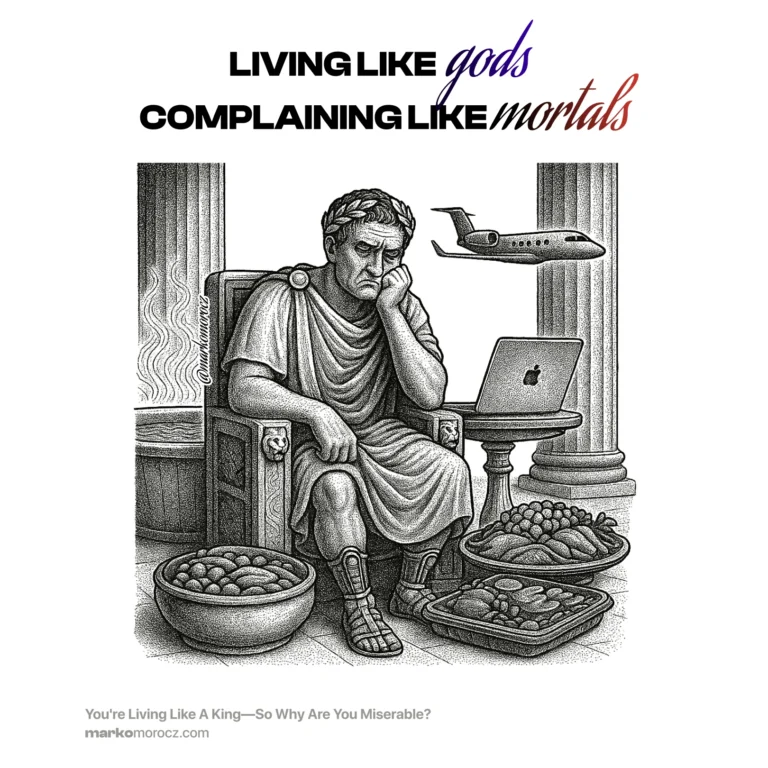
You’ve got a new boss. More demanding than any human you’ve ever worked for.
Your lifestyle.

The Lifestyle Prison: Your Golden Chains
Every upgrade becomes a chain. Every luxury becomes a liability. Every “I can finally afford this” becomes “I can never give this up.”
The math is brutal.
$4,000/month mortgage = $48,000 annual prison sentence
$1,200/month car payments = $14,400 yearly handcuffs
$2,000/month private school = $24,000 education debt
$500/month country club = $6,000 social obligation
Total annual lifestyle overhead: $92,400
This person doesn’t work for money anymore. They work for their mortgage, their car note, their kid’s tuition, their social status.
They make half a million and feel broke. Because they upgraded everything instead of choosing strategically.
The Wedding Revelation: How 3 Beats Everything
When friends get engaged, they face the classic trap. Wedding pressure. Everyone has opinions on what they “need.”
Elaborate cake. Designer dress. Party favors. Upgraded everything.
They’re drowning in expensive obligations.
Then I shared a wisdom I heard that changed their lives.
Pick the three things that matter most. Splurge on them. Get exactly what you want. For everything else, be frugal.
Permission to invest in what matters. Obligation to ignore what doesn’t.
The result? Best day of their life. Reasonable price. No elaborate cake. Simple flowers. No party favors.
But their three chosen elements? Perfect.
The rule worked so well for them, I apply it to everything.
The Entrepreneur Death Trap: When Income Swings
For entrepreneurs, lifestyle inflation isn’t just expensive—it’s lethal.
Corporate workers get raises, They upgrade their lifestyles. They rely on steady paychecks.
Entrepreneurs? Income swings wildly. But if you’ve inflated across every category, you’ve created a financial floor you can’t fall below without devastating consequences.
I’ve watched people go from feeling free at $100K to feeling trapped at $500K. They upgraded everything instead of choosing strategically.
The result?
Can’t take a month off. Can’t turn down work they hate. Can’t experiment with ideas that might not pay immediately. Can’t pivot when opportunities arise.
Freedom? Replaced by golden handcuffs of their own making.
My Current Rule of 3: The Freedom Formula
I still use this framework. I fight the urge to upgrade everything when we see other entrepreneurs living differently.
Our current three strategic splurges:
1. Quality nutrition, gym membership and preventative measures (e.g., tests, interventions)
Invest in our bodies like they’re our only vehicles. Non-negotiable health optimization.
2. Two higher-end restaurants monthly
Experiences that become memories. Shared moments that compound over time.
3. Travel without anxiety (WIP)
Go where we want, when we want, how we want. Budget: whatever it takes for the experience we’re after.
Everything else stays basic.
Drive a Peugeot. No fancy watches. Housing costs deliberately low.
Why? Because this gives me something money can’t buy. The option to say no to work I don’t want, and yes to experiments that might not pay immediately.
How To Choose Your 3: The Strategic Method
This isn’t casual brainstorming. This is strategic warfare against your own impulses.
Step 1, The Spending Audit: Track every non-essential expense for one month. Housing, basic food, basic transportation don’t count.
Look at the list. How much actually moves your happiness needle?
Step 2, The 5-Year Question: “If I can only splurge on three categories for the next 5-10 years, what would they be?”
Not what sounds impressive. What will actually support your happiness and goals.
Step 3, The Specificity Test: Vague kills the strategy.
“Health and fitness” = spending on every supplement, gadget, program
vs.
“Gym membership and massage twice monthly” = clear boundaries
Step 4, The Partner Alignment: If you have a partner, this is non-negotiable teamwork. One person’s strategy destroyed by the other’s impulses = guaranteed failure.
If you’re single, you have an advantage: complete control over the decision. Use it.
Step 5, The Opportunity Cost Reality: For every category you’re considering: “What am I giving up by choosing this?”
Choose like your freedom depends on it. Because it does.
The 3 Fatal Mistakes That Kill Everything
Mistake 1: Category Creep
“Just this once” becomes “just this time” becomes “maybe we need four categories.”
When you expand beyond three, you’re back where you started. Flexing for everything, free to enjoy nothing.
Mistake 2: Ego-Driven Choices
Selecting categories that sound impressive instead of identifying what actually makes you happy.
Your three should sometimes embarrass your ego. They should reflect your actual values, not your imagined ones.
Mistake 3: Boundary Erosion
“Looking good” becomes spending on every style guru’s recommendation. “One professional wardrobe refresh yearly” has clear limits.
Specificity is freedom. Vagueness destroys everything.
The Compound Effect: What Actually Happens
- Month 1: Your ego screams. “But what about X?”
- Month 3: Decision-making becomes effortless. Clear yes/no criteria.
- Month 6: Genuine appreciation for your chosen three deepens.
- Year 1: Financial stress evaporates. Freedom increases exponentially.
- Year 5: You become unrecognizable from upgrade-everything culture.
You’ve built something rare. Intentional life.
The Research That Destroys “More Is Better”
Barry Schwartz’s “Paradox of Choice” research proves what entrepreneurs learn painfully. More options decrease satisfaction1.
Key findings:
- People with 3-5 priorities report 67% higher life satisfaction than those optimizing everything2
- Constraint-based decisions reduce decision fatigue by 40%3
- Strategic limitation increases both creativity and contentment4
Your brain isn’t designed to optimize infinite variables. It excels within defined parameters.
Give it three categories. Watch it work magic.
Real-World Applications: The Strategic Examples
Tech Entrepreneur (3 Categories):
- High-end productivity setup (monitors, chair, software)
- Adventure travel quarterly
- Weekly personal training
Everything else: basic. Drives old Honda. Lives in modest apartment. Net worth: $2M. Stress level: minimal.
Creative Professional (3 Categories):
- Premium art supplies and workspace
- Continuing education and workshops
- Quality coffee and local restaurants
Everything else: thrifted clothes, basic car, roommates. Freedom level: maximum.
The Pattern: Intentional splurging on what matters most. Strategic frugality on everything else. Result: both financial security and lifestyle satisfaction.
The Arena Reality: Choose Your Battles
In life’s arena, everything is a battle you can’t win.
You have limited resources. Time. Money. Attention. Energy.
Spread them across infinite battles, lose them all. Concentrate them on three strategic battles, dominate completely.
The wealthy person struggling up the trail, weighed down by excess gear, will never reach the summit.
The strategic climber with three perfectly chosen tools? They’re already enjoying the view from the top.
The Implementation Tool: Your Strategic Spending List
Here’s the brutal truth about implementation. Objects feel “real”. Experiences feel abstract.
A new cycling jersey? Easy to justify. A blood panel test? Harder to rationalize in the moment.
This tangible bias destroys even the smartest strategies.
Use a spending list. Before any non-essential purchase, it goes on the list first. Four categories:
- Category 1 Items (your first chosen area)
- Category 2 Items (your second chosen area)
- Category 3 Items (your third chosen area)
- Everything Else (automatic no)
The 48-Hour Protocol: Wait minimum two days. Ask: “Which category does this serve?”
If it’s “Everything Else” → pass. If it’s one of your 3 → prioritize against other items in that category.
Example: Blood panel test (essential for health optimization) vs. new cycling jersey for Zone 2 rides (want, not need). The blood panel serves my health category. The jersey is “Everything Else.”
The list becomes your anti-impulse weapon. Visual reminder of strategic choices vs. random wants.
You’re not restricting spending. You’re directing it toward what actually serves your mission.
The rule isn’t about deprivation. It’s about concentration. It’s about building a life so aligned with your actual values that every dollar becomes a vote for who you really are.
Your three categories are waiting.
Choose them like your freedom depends on it. Because it absolutely does.
What are your three?
Comment below. Let’s build freedom together.
References
- Schwartz, B. (2004). “The Paradox of Choice: Why More Is Less.” Harper Perennial. ↩︎
- Sonja Lyubomirsky, et al. (2005). “Pursuing happiness: The architecture of sustainable change.” Review of General Psychology, 9(2), 111-131. ↩︎
- Baumeister, R. F., et al. (1998). “Ego depletion: Is the active self a limited resource?” Journal of Personality and Social Psychology, 74(5), 1252-1265. ↩︎
- Stokes, P. D. (2006). “Creativity from Constraints: The Psychology of Breakthrough.” Springer Publishing. ↩︎