Padel: The Racket Sport You Can Actually Enjoy From Day One
Tennis is the ultimate racket sport. Maximum longevity gains, deepest skill ceiling, highest fitness demands. But most people quit before they get good enough to enjoy it.
Padel solves this problem.
You can have fun during your first match. You can hold a rally on day one. You can feel competent before you’ve mastered the technique. And if you stick with it long enough, the strategic depth reveals itself. Walls become weapons, positioning becomes everything, and the game transforms into something far more interesting than it looked from the outside.
This is the case for padel as the fastest on-ramp to racket sports. And exactly what you need to know before your first session.
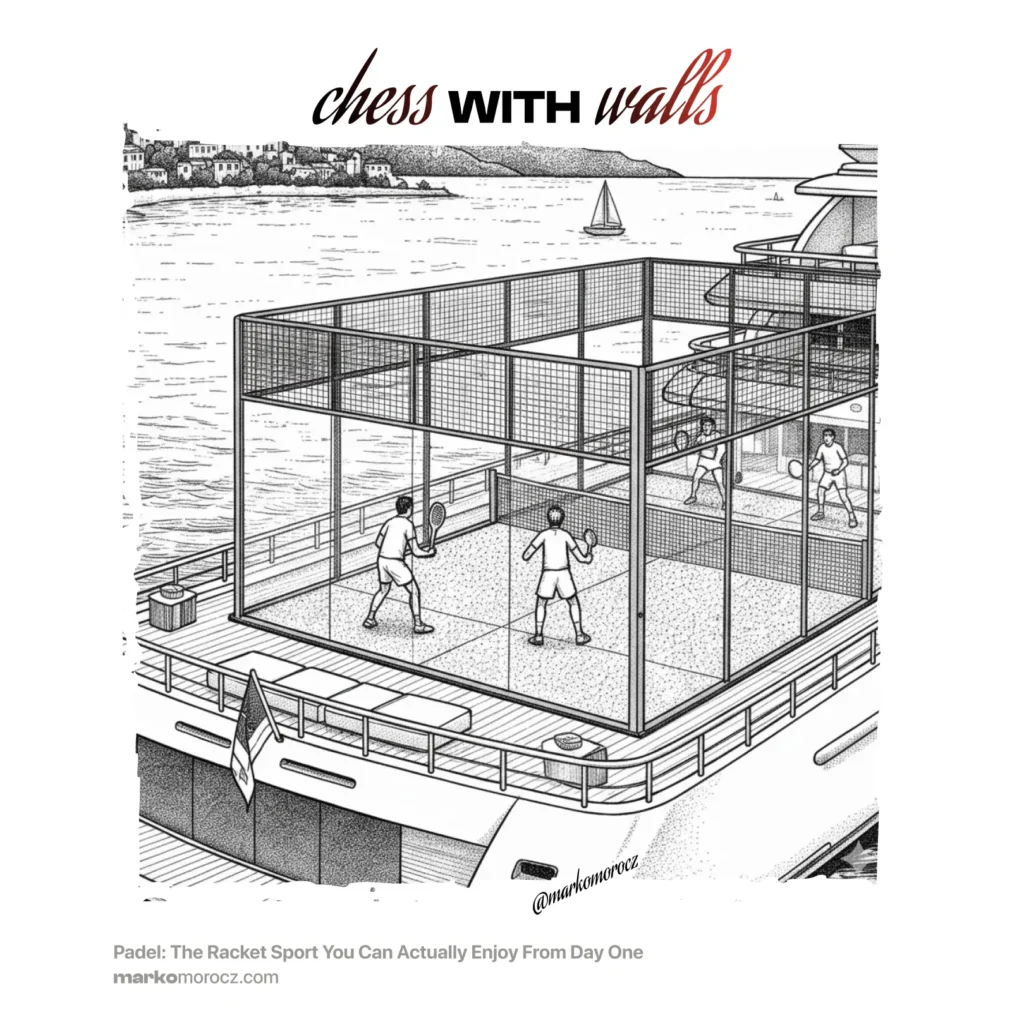
Why Padel Works Where Tennis Intimidates
Tennis punishes beginners. Miss the serve box by six inches and you’ve donated a point. Hit with too little topspin and the ball sails long. Hit with too much and it clips the net. The feedback loop is brutal for someone who just wants to enjoy hitting a ball.
Padel forgives. The walls keep balls in play that would be out in tennis. The smaller court means less ground to cover. The doubles-only format means your partner compensates for what you don’t know yet. You spend more time in rallies and less time chasing balls you can’t reach.
The learning curve looks like this: tennis takes months to stop feeling incompetent, padel takes one session.
But the skill ceiling is real. The walls aren’t just safety rails. They’re strategic tools that create angles tennis can’t offer. The best padel players aren’t just good tennis converts. They’ve mastered an entirely different tactical game.
The Wall Geometry People Complicate
Most beginners treat walls like accidents. The ball hit the glass because they mishit. Wrong frame entirely.
Walls are intentional tools. The back wall gives you time. Let a difficult ball bounce off it and you’ve bought yourself a second to set up properly.
The side walls create cross-court angles that don’t exist in tennis . Hit the side glass at 45 degrees and the ball runs diagonally across the court, pulling your opponent wide.
The glass provides clean rebounds. The wire mesh is unpredictable but still usable. Learn which wall does what and you’ve unlocked half the game.
The other half is position.
Position Over Power (Always)
Tennis rewards big serves and baseline bombs. Padel rewards controlling the net.
The golden rule: own the front third of the court and you control the match. The team at the net dictates tempo, forces defensive shots, and finishes points. The team stuck at the baseline is surviving until they can push forward.
This isn’t static positioning. You move forward when the opportunity allows it. Typically after forcing a weak return or placing a deep shot that pins opponents back. You retreat when a lob goes over your head. The game is constant transition between zones: attack at the net, defend from the back, transition through the middle.
Power without position is wasted energy. A 150 km/h smash from the baseline loses to a well-placed volley from the net. Every time.
The Four Shots That Actually Matter
You don’t need fifteen different strokes. You need four that work.
The Bandeja (Defensive Overhead): When a lob goes over your head, slice it back deep with backspin. Keeps you alive when others would lose the point. Buys time to reset position.
The Víbora (Attacking Topspin Overhead): Mid-court opportunity ball gets hammered down with topspin. Combines power with placement. This is your finishing weapon when opponents are out of position.
The Chiquita (Attacking Return): Attack the server’s feet with topspin on the return, forcing them to lift the ball. Immediately flips control in your favor. Most effective way to neutralize a strong serve.
The Dejada (Drop Shot): When opponents are deep, drop it soft over the net. Forces exhausting forward sprints and creates chaos in their positioning.
Master these four. Everything else is refinement.
Communication Is Half The Game
Padel is doubles-only for a reason. The game rewards partnership over individual heroics.
Essential calls: “Mine” or “Yours” eliminates confusion on balls near the center line. “Switch” coordinates position changes when you’ve crossed sides. “Short” or “Deep” alerts your partner to ball trajectory. “Glass” or “Wire” warns which wall type to expect on rebounds.
Great padel teams aren’t two good players standing on the same court. They’re one strategic unit with four arms and perfect coordination. The best teams I’ve played with don’t need long conversations. They know each other’s tendencies, cover weaknesses automatically, and communicate in shorthand that evolves over dozens of matches together.
If you’re playing with a regular partner, invest in building that partnership. It’s worth more than individual shot improvement.
The Serve Isn’t About Aces
Tennis players arrive expecting to win points on serve. Padel doesn’t work that way.
The serve in padel is about setting up the third ball. You serve, they return, you attack with the third shot. Most points are won or lost on that third ball. This means your serve strategy should be built around creating an easy third-ball attack opportunity.
Useful serves: body serve jams the returner and forces a weak defensive return. Wide serve pulls them off court and opens space. Kick serve bounces high and disrupts timing. Slice serve stays low and forces lifting.
None of these are trying to be aces. They’re all trying to make the third ball easier to finish.
What Tennis Players Get Wrong
Tennis instincts actively hurt you in padel. Here’s what to unlearn.
Hitting harder doesn’t win more points. Placement beats power unless the placement is so weak that power can exploit it. Most tennis converts overhit for the first month and donate points to opponents who just keep the ball in play.
You can’t dominate from the baseline. The court is too small and the walls keep too many balls alive. You have to move forward. Staying back is survival, not strategy.
The net is closer than it looks. Tennis players hang back because the net feels far away in a full-sized court. In padel the net is right there. Get to it.
The Longevity Case For Racket Sports
Research shows racket sports add up to 9.7 years to lifespan — the highest longevity gains of any physical activity measured.1 Tennis sits at the top of that category. Padel inherits most of those benefits while being easier on joints.
The artificial turf with sand infill is forgiving. Less explosive running than tennis means knees last longer. More strategic positioning than pure athleticism means you can play intensely at seventy the same way you played at thirty.
Your brain stays sharp from reading opponents and adapting tactics mid-match. Your social connections flourish from the doubles-only format. Your body gets the cardiovascular and coordination work without the joint-destroying impact of running sports.
Padel isn’t a replacement for serious fitness training. But as a sport you can play for decades without breaking down, it’s legitimately one of the best options available.
Getting Started Right
Find a local padel club. Book a beginner lesson. One session with an instructor is worth five sessions of trial and error. Show up with a partner if possible since the game is built around doubles chemistry.
Equipment: Start with a control-oriented racket (softer surface, more precision). Weight around 360-370 grams for maximum touch. Upgrade to a balanced or power racket only after you’ve developed consistent technique.
I started off with a Nox X-One Silhouette racket. After a season I upgraded to Kuikma Hybrid Pro racket loved by Lucia Sainz (top 20 player globally).
Expectations: First session you’ll feel competent enough to enjoy it. First month you’ll start seeing strategic patterns. First year you’ll realize the skill ceiling is far higher than it looked and you’re nowhere close to the top.
The game reveals itself slowly. That’s the appeal.
The Bottom Line
Tennis is the king of racket sports for longevity, skill development, and fitness. But most people never get good enough at tennis to enjoy it.
Padel gives you the enjoyment immediately and the depth later. You can have fun during your first match. You can feel progress every session. You can build a regular group and play for decades without your knees giving out.
The walls aren’t obstacles. They’re your strategic partners. The court isn’t a tennis court with barriers. It’s an entirely different game with different rules and different rewards.
Book a session. Learn the walls. Find a regular partner. The fastest-growing sport on the planet is growing fast for a reason.
Pick your obsession. Master it.
References
- Schnohr, P., et al. (2018). “Various leisure-time physical activities associated with widely divergent life expectancies: the Copenhagen City Heart Study.” Mayo Clinic Proceedings, 93(12), 1775-1785. ↩︎